Why Morning Routines Are Scientifically the Most Stressful Part of a Parent’s Day (And How to Fix It)



If you have ever found yourself standing in the kitchen at 8:00 AM, clutching a lukewarm cup of coffee while pleading with your child to put on their second shoe for the seventh time, you are not alone. In fact, science confirms what millions of parents feel intuitively every morning: the school morning rush is the single most stressful window of the entire week.
While evening bedtime routines get plenty of attention, developmental psychologists and stress researchers have found that morning transitions trigger a unique psychological and physiological storm in family households. Below, we examine the landmark research behind morning panic and explore science-backed strategies to bring lasting calm to your home.

Survey data mapping daily stress levels hour-by-hour suggests that early morning pressure reaches a sharp climax for most adults:
"7:23 AM is the average peak moment for daily stress, with many people encountering their first stressful event before 8:00 AM" (OnePoll & Rescue Remedy, 2023).
Beyond consumer survey data, physiological research confirms this acute morning spike. In a study examining working mothers, researchers found that combining parenting demands with workday pressure significantly elevated morning cortisol levels and altered the Cortisol Awakening Response (CAR) via the hypothalamic-pituitary-adrenal (HPA) axis (Hibel et al., 2012).
Why do early mornings hit so much harder than evenings?
Parents often assume that issuing a warning like "We have to leave in 5 minutes!" provides a clear, actionable signal. However, developmental cognitive neuroscience reveals why this approach repeatedly fails.
A child’s capacity to track time, plan ahead, and regulate behavior depends on executive functioning—a suite of cognitive processes mediated by the prefrontal cortex (Best & Miller, 2010). Because the prefrontal cortex undergoes a remarkably protracted maturation process extending into early adulthood, young children experience environment-driven "time blindness."

Children aren't being stubborn when they move slowly like Sam the Sloth—their brains simply process time as a sequence of events rather than a ticking clock.
By 8:00 AM, the average parent has already issued between 20 and 40 micro-directives: "Eat your toast," "Grab your backpack," "Where are your socks?", "Don't touch your sibling."
This constant stream of verbal instruction creates two damaging feedback loops:
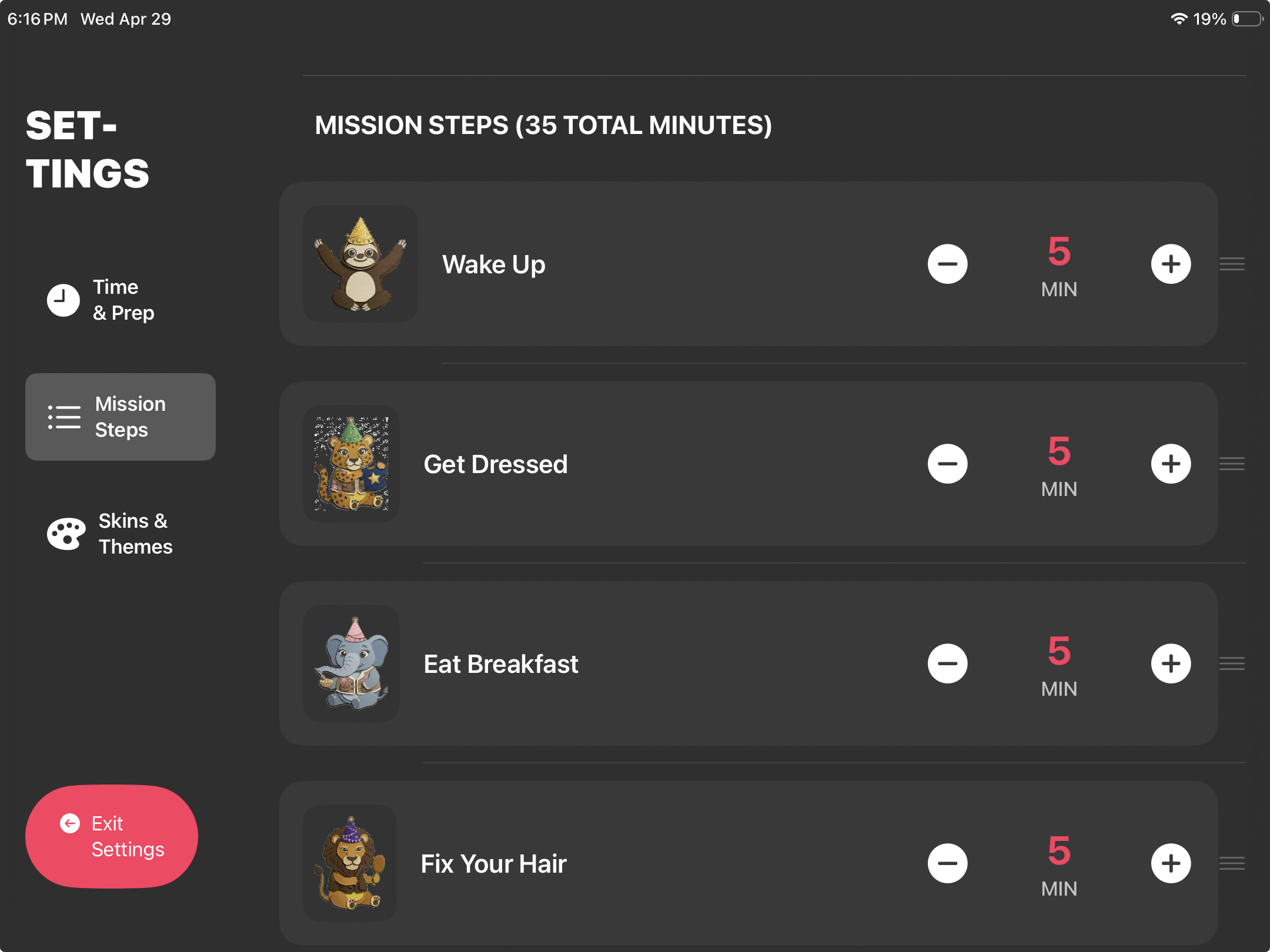
How do we break this cycle? Pediatric behavioral specialists and intervention researchers recommend shifting from verbal nagging to objective visual systems.
Research demonstrates that Visual Activity Schedules (VAS) serve as antecedent environmental cues that lower working-memory burdens, decrease transition delays, and foster independent task execution without constant verbal prompting (Hume et al., 2014; Knight et al., 2015; Meadan et al., 2011).
When a routine is visual, linear, and standardized, the burden of enforcement shifts away from the parent and onto a neutral external anchor. The parent stops acting as the "nagging warden" and becomes a supportive coach.

When kids can see their progress—like moving from Austin the Lion at doing hair to Zoe the Zebra putting on shoes—they gain a sense of autonomy and pride.
Put an end to morning stress. The Morning Map turns morning routines into an engaging, visual trek led by Toucan Tommy—giving your kids independence and restoring peace to your home.
Available on Apple (iOS & Apple TV) • Roku • Expanding to Amazon Fire TV & Android TV